
I did not start my career in freight.
Before founding Buildcargo, I spent about a decade in furniture retail. In my last complete operating year as a regional general manager, the business under my management recorded approximately RMB 1 billion in retail sales. That was the scale of the furniture business—not my personal sales and not Buildcargo revenue.
I mention it for one reason: those years trained me to look at the product before I look at the freight rate—and to ask what happens to that product at every later handover.
That habit mattered in a recent U.S. door-and-window project. Before packing began, the customer had already told the factory to pay attention to the finished dimensions and make the necessary adjustments. The factory replied that it would pack the cargo according to its experience.
The problem was not that nobody cared about the packing. The problem was that the factory’s experience focused on protecting the product, while the shipment needed a packing plan built around the whole route.
After the cargo reached the warehouse, our final record showed eight packages weighing 5,612 kg and measuring 37.66 cubic metres. The longest package was 5.36 metres.
For the container and loading method used in this project, our preferred planning target was to keep the product body within 2.40 metres before protection. After allowing for both corner protection—roughly 8–10 centimetres—and the additional working clearance, we set about 2.55 metres as this project’s final packed target for entering the container.
This is a project-specific loading target, not a universal limit for every container or route.
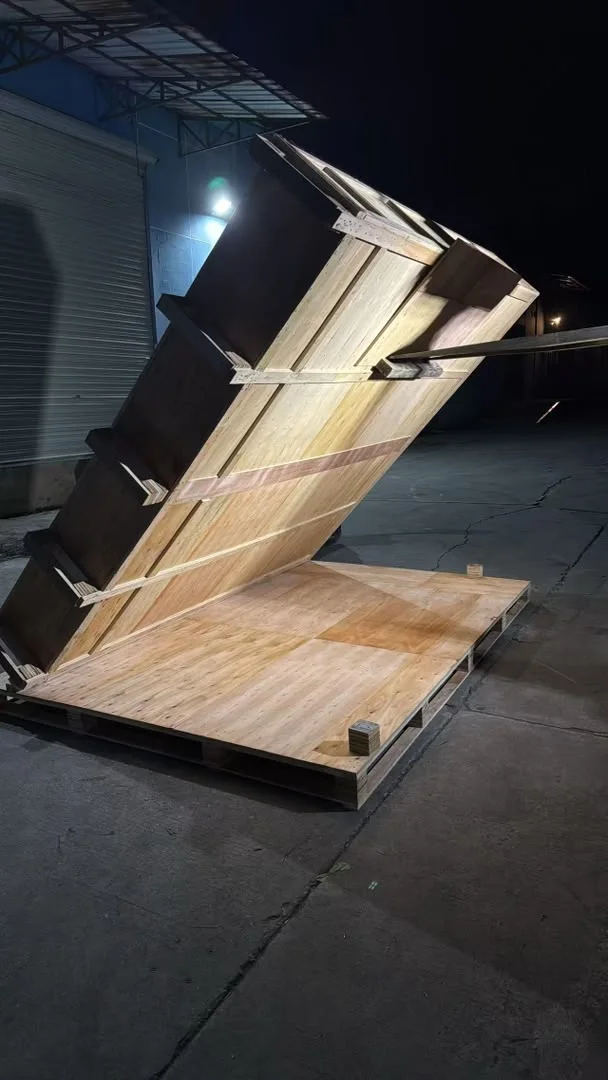
The factory fixed the corner blocks to the side instead of the front face. As a result, even the shortest loading height was 2.61 metres. Six centimetres may sound minor on a factory floor. At the container door, it changed the answer from “loadable” to “cannot enter in this orientation.”
The packing had to be modified. The repacking work alone cost more than RMB 2,000—before counting the downstream cost risk created by the longest pieces.
Some packages were also too long for the ordinary U.S. final-mile truck and tail-lift arrangement planned for this route. That planned arrangement could not unload them. That meant a different vehicle or unloading method would be needed, raising the cost of the whole shipment. A factory can therefore make a package strong enough to leave the factory while still making it unnecessarily expensive to deliver in the United States.
The timing made the problem more serious. The customer had requested an urgent shipment: the cargo needed to be loaded the following day, gated into the port yard and prepared for customs declaration. The factory finished production only one day before that loading deadline.
There was no normal correction window. If we wanted to protect the next day’s plan, the packing had to be adjusted that night.
We stopped treating the packages as ready cargo. Our team explained the height and loading problem to the customer, redesigned the support, changed the loading orientation and continued the packing correction after hours. The corrected structure then had to be checked again before the cargo could return to the loading sequence. At the same time, the operations team kept coordinating the next loading and sailing milestone.
The customer could see that several concerns had been raised and asked whether they had been resolved. After the correction was explained, the reply was short: “Awesome, nice job.”
I like that message because it was not praise for a perfect shipment. It came while the project was still active. The customer had seen a problem, asked a direct question and received a concrete answer.
The expensive lesson was not simply that one package was six centimetres too high. It was that packaging dimensions affect at least three different stages: entering the container in China, choosing the final-mile vehicle in the United States and deciding how the cargo can be unloaded at the address.
That is why I do not believe “the factory will pack it based on experience” is a complete shipping plan. The factory needs a written logistics brief before packing: the container type and door clearance, loading orientation, final packed limits, longest-piece restrictions, destination vehicle and unloading method.
This project is still active, so I am not presenting it as a completed U.S. delivery. It does not prove that delays can always be avoided. What it proves is narrower and more useful: the oversize issue was identified before loading, the customer was kept informed, the support was rebuilt after hours, and the cargo moved back toward a workable loading plan.
That is what experience means to me now. It is not the number of years printed in a company profile. It is translating the whole route into packing instructions before production finishes—and having a team that can still respond when that did not happen in time.
Experience is translating the whole route into packing instructions before production finishes.