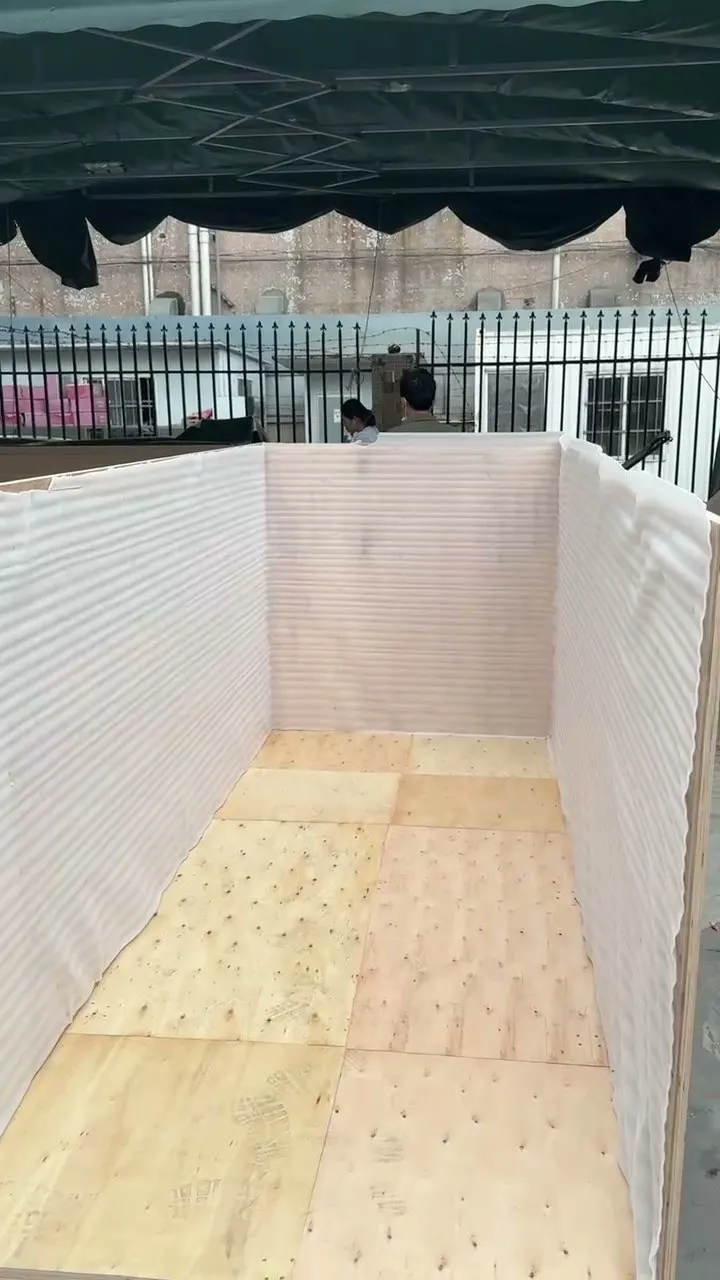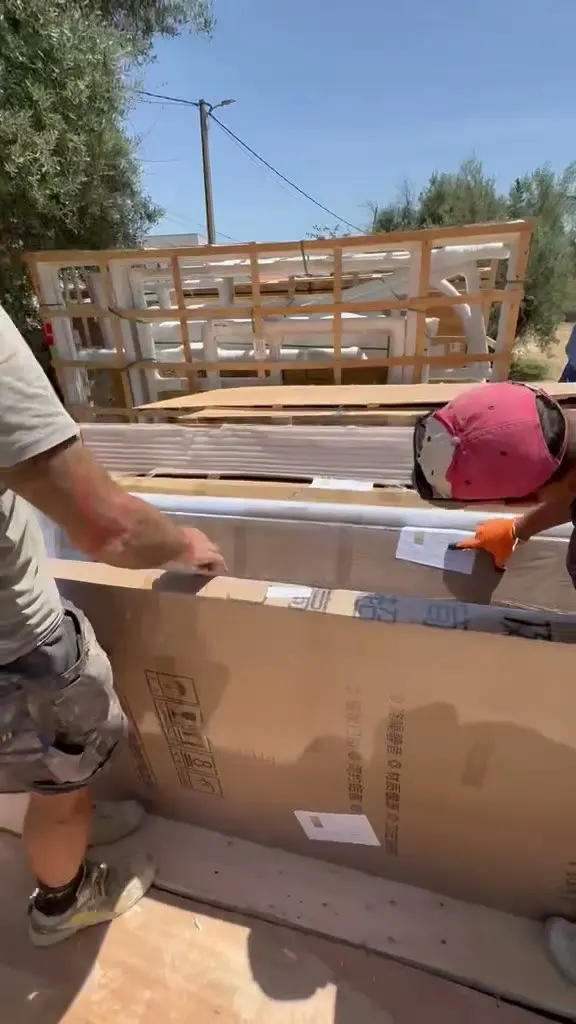
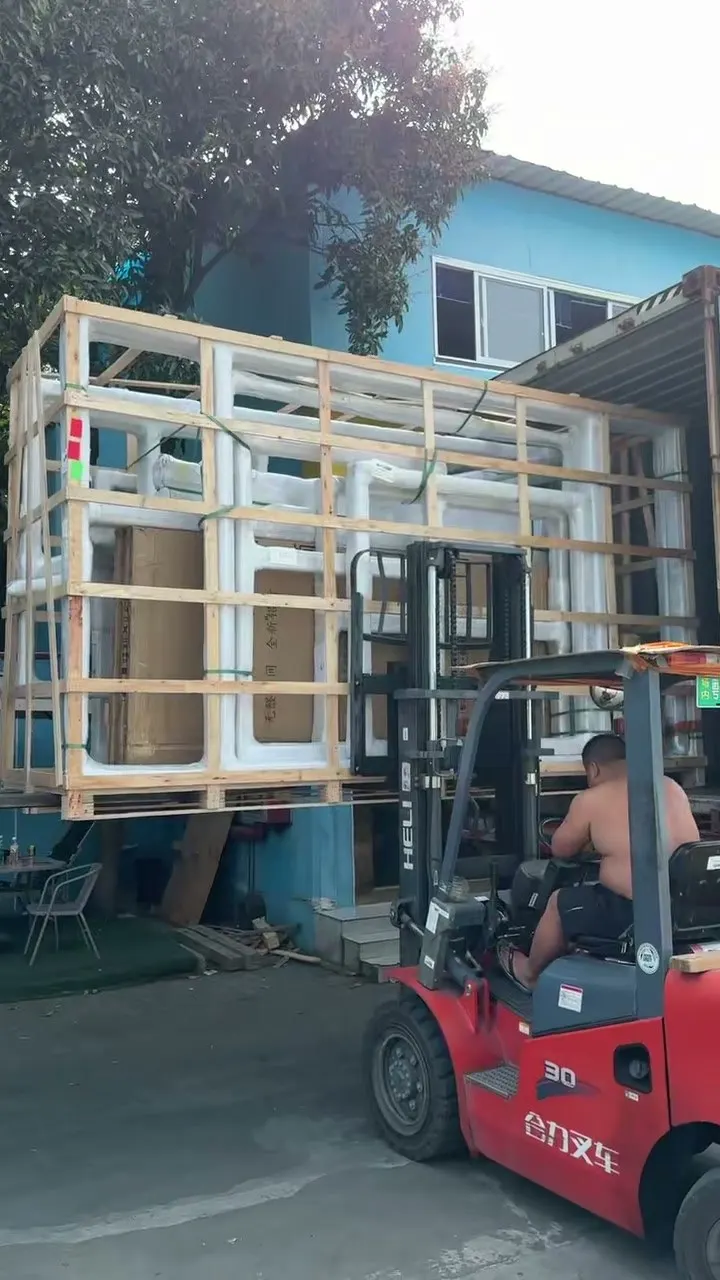
There were 49 packages in this Spain shipment, but one of them decided how we had to approach the loading work.
The factory had packed all of the glass into one wooden crate. It weighed close to one tonne. The glass had to stay in a fixed direction, but the crate did not arrive with the large load-bearing corner supports we needed for the planned handling and securing.
That combination mattered more than the product name. A nearly one-tonne crate is not difficult only because it is heavy. Its centre of gravity, lifting position, orientation and supporting structure decide whether a forklift can move it without making the crate lean, twist or take force through the wrong corner.
This is one place where technical guidance becomes practical. Pilkington’s handling instructions say glass resting on a storage rack should be kept at 5–7 degrees from vertical. SCHOTT’s instructions for moving safety glass in wooden crates say the crate should remain upright, perpendicular to its base, without twisting or distortion under load. Those are not competing rules: one describes glass on a rack; the other describes a closed crate being moved. The lesson for us was not to copy one angle blindly. It was to keep this crate in its required orientation and support the structure carrying the weight.
We used two forklifts at the same time to change the crate’s direction and hold it under control. This was not simply “twice the lifting power.” The operators had to move in sequence so that one side did not suddenly take the load or twist the crate. With the crate held in the correct position, the team fitted the missing large corner supports and prepared it for loading.
The next decision happened inside the container.
We did not put the glass wherever there happened to be a gap. Its position had to work with the weight distribution of the full load, the container floor and the crate’s fixed direction. The cargo beside it needed to be stable, firmly packed and able to form part of a broad load-supporting arrangement—not loose hardware, a rolling item or a hard point that could strike the glass crate. We kept hard point contact away from the glass and used load-spreading, blocking and securing so the crate could not work forward, backward or sideways during the journey.
Neighbouring cargo can help fill a void. It should never be the only thing stopping a nearly one-tonne glass crate from moving. The IMO/ILO/UNECE CTU Code makes the same practical distinction: blocking and bracing are meant to transfer forces through suitable structures, and very heavy packages may need blocking and lashing together.
This is also why directly controlling the container loading matters to us. We were not only passing a booking to another operator and waiting for a loading photo. Our team was responsible for the actual stuffing decision: where the glass sat, what could sit beside it and how the restraint would be checked before the doors closed. That is an operational advantage, not a criticism of another company’s business model.
The completed shipment totalled 49 packages, 4,620 kg and 30.51 cubic metres. It was loaded on March 24, passed through Rotterdam and completed residential delivery in Spain on May 25. The customer confirmed that all of the glass arrived without damage.
That last sentence sounds simple. The work behind it was not. The useful experience in this project was visible in three decisions: use two forklifts instead of forcing one awkward move, add the missing corner support, and control the glass crate’s exact relationship with the cargo around it.
Neighbouring cargo can help fill a void. It should never be the only thing stopping a nearly one-tonne glass crate from moving.