
The work behind your shipment
From factory to home: the 15-stage shipping process.
You have bought furniture or building materials in China. Here is what happens between the factory handover and your delivery address—and what to confirm before each stage.
The whole route, in one view
Fifteen stages. Four things to keep clear.
Costs, cargo care, timing and compliance. This is a sea-freight overview, not a fixed sequence for every order: packing can be checked or changed after warehouse arrival, and some stages overlap. Air and land routes use the corresponding loading and border procedures.
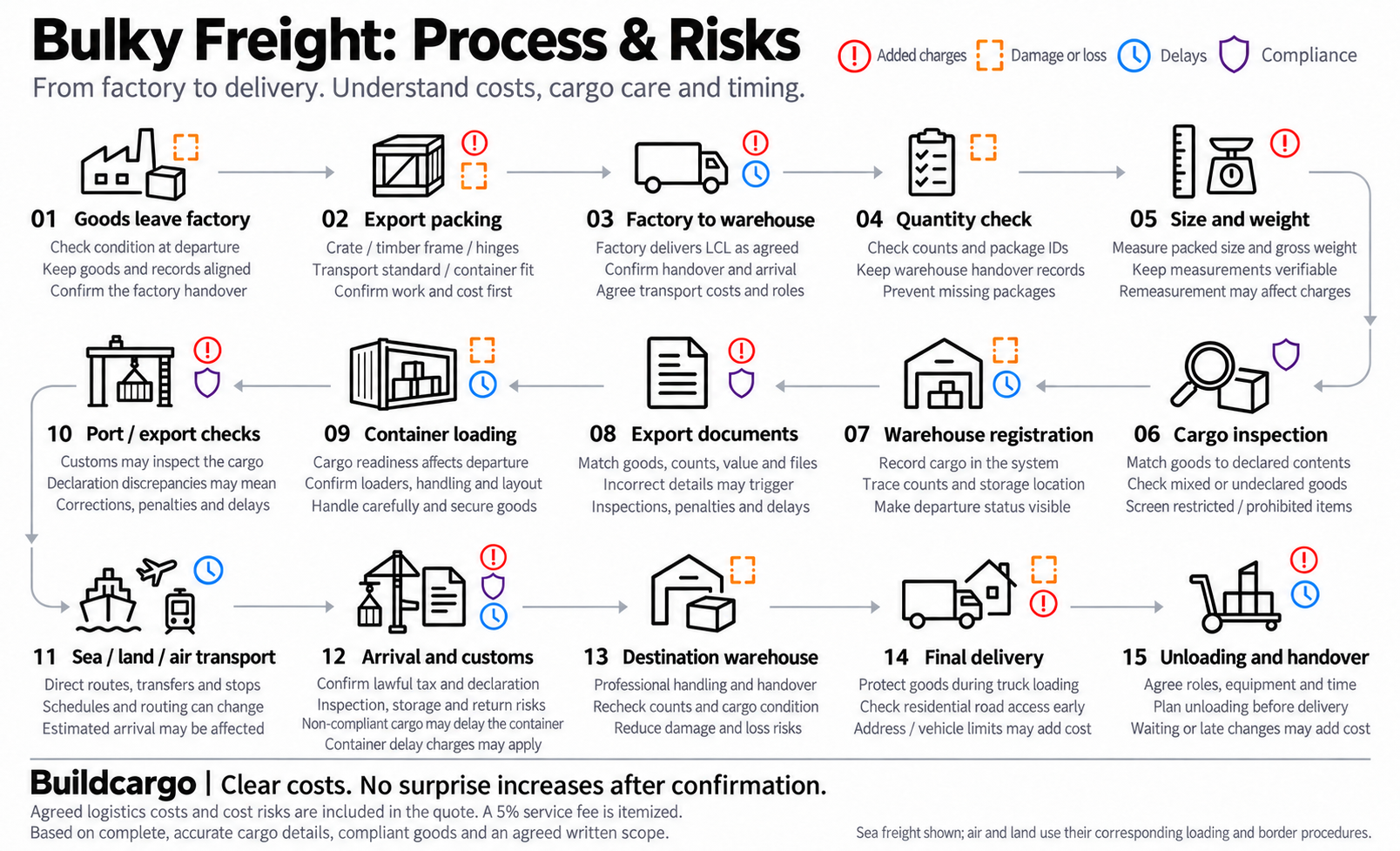
Diagram fee note. The supplied illustration mentions a 5% service fee. This is not a standard rate for this website. Any service fee, its calculation basis, included work and exceptional charges must be confirmed in your shipment’s written quotation and agreement.
Enlarge the complete 15-stage map
Keep the written scope beside the picture. The supplied illustration mentions a 5% service fee. This is not a standard rate for this website. Any service fee, its calculation basis, included work and exceptional charges must be confirmed in your shipment’s written quotation and agreement.
Scroll within the map to read it at full size. All 15 stages are also available below as normal text.
Stages 01–05
Prepare the cargo. Verify the numbers.
Goods leave the factory
Identify the supplier, goods, package count and ready date. Agree who hands the shipment over and keep the order reference connected to the cargo.
Confirm: The collection point, handover record and any supplier delivery or collection charge.
Prepare export packing
Suitable factory packing can stay. Weak or unsuitable packing may need bracing, reinforcement or replacement; agree the work and price before it starts.
Confirm: Packed size, safe handling and container fit—not just whether a wooden crate exists.
See packing choicesDeliver to the China warehouse
A supplier can deliver under the receiving instructions, or collection can be arranged as quoted. Label separate supplier batches so they can be matched to one project.
Confirm: Receiving reference, arrival arrangements, transport responsibility and charges.
Record the packages received
Basic receiving records package count, labels, visible outer condition and obvious differences. An arrival record is not a detailed check of every product inside.
Confirm: Which batches arrived, how many packages were received and any photographed exception.
What basic receiving checksMeasure packed size and weight
Measurements of the packed cargo help determine the charging basis and loading plan. Added packing changes those dimensions; supplier estimates are not warehouse measurements.
Confirm: The recorded length, width, height, gross weight and charging method behind the quote.
Open the Poland measurement record
Stages 06–10
Check the details. Agree the dispatch.
Review cargo and declarations
Check the cargo information against the declared contents and acceptance rules. Visible and document checks do not mean opening every package, product certification or functional testing.
Confirm: Accurate contents and any restricted or specially declared goods before acceptance.
Check accepted cargoKeep the warehouse record connected
Connect supplier references, package counts and storage records. Your contact can explain which goods are ready, which are still missing and what needs action.
Confirm: The receiving status, storage period and records to be shared for your order.
Prepare export documents
Coordinate the supplier’s product information and packing list. Goods, quantities, values and documents must agree; an inaccurate declaration can create correction, penalty or delay risks.
Confirm: Product descriptions, declared values, documents and the agreed customs responsibility.
Understand shipping documentsLoad and secure the shipment
Once cargo, packing and documents are ready, confirm the loading and dispatch arrangement. Shared-container cargo can join consolidation; that is not a promise of a daily sailing.
Confirm: Loading arrangements and records. Ocean-freight payment follows container loading; other modes are agreed separately.
See loading records and payment termsPort and export checks
Cargo moves through the applicable port and export procedures. Customs may inspect it; a check is not proof of wrongdoing, and a careful plan cannot guarantee no examination.
Confirm: Document corrections, examination handling and any exceptional charge under the agreement.
Stages 11–15
Follow the route. Prepare the handover.
International transport
Confirm whether the route is direct or includes transfers and port stops. Read the start and end points of a transit estimate: arrival at port is not delivery to your home.
Confirm: The planned departure, route, estimated milestones and how changes will be explained.
Read transit-time boundariesArrival and import clearance
Complete the agreed import and tax arrangements. Inaccurate declarations or non-compliant cargo can affect clearance and other cargo sharing a container; lawful low tax or third-party handling alone is not a sign of misconduct.
Confirm: Importer arrangements, named duties and taxes, and who handles inspection, storage or delay costs.
Check the written DDP scopeDestination warehouse or transfer
Where the route uses a destination warehouse, record package counts, visible condition and the next handover. Not every shipment uses the same warehouse or transfer pattern.
Confirm: The actual operator, storage arrangement and handover records for this route.
See the European warehouse examplePlan the final delivery
Check the postcode, road access, vehicle size and appointment before delivery. A smaller vehicle or a special address can change the plan and cost; confirm it before the affected work.
Confirm: The agreed vehicle-accessible handover point—not an assumed inside-room service.
Prepare the delivery addressUnload and complete the handover
Arrange suitable equipment or workers in advance when needed. At handover, check package count and visible condition, record exceptions and keep the relevant photos and delivery notes.
Confirm: Who unloads, any waiting charges, and whether carrying inside, stairs or installation are separately included.
Know the insurance and claims process
Before you commit
Compare what the price actually covers.
You should be able to see what is measured, what work is included and where responsibility changes—not discover those details only after handing over the goods.
Dimensions you cannot verify
Ask for packed measurements and the charging method. If reinforcement changes the size, the final quote should explain the difference.
A departure plan left unstated
Ask whether dispatch depends on missing supplier goods, a future consolidation or a discounted sailing. Confirm transfers and stops—not just a headline transit time.
Taxes without a clear basis
Compare the named duties, taxes and import arrangements. A lawful rate is not a problem; false values or incomplete declarations are.
Handovers without records
Several operators can legitimately handle a route. What matters is a clear package count, cargo-condition record and responsible contact at each handover.
Undeclared or non-compliant mixed cargo
Ask about cargo acceptance and declaration controls. Goods needing special handling are not automatically illegal, but undisclosed or non-compliant cargo may affect a shared container.
A price without a service scope
Compare collection, packing, documents, freight, clearance, named taxes, storage and final handover. Write down exclusions and exceptional charges before dispatch.
Your written plan
A final price before dispatch. Clear payment and delivery terms.
Price confirmation
After the planned goods have arrived and been brought together, we review the measurements and packing and confirm the final price and scope in writing before dispatch. An initial estimate is not the final quote.
With cargo, packing, route, address and scope unchanged, ordinary freight-rate movements do not change the confirmed freight. Changed cargo, added services and contract-defined exceptional charges need a separate explained written confirmation.
Read the existing price-confirmation policy →Payment and home handover
For sea freight, payment follows loading into the container. This is different from loading aboard the vessel. Other modes follow their agreed terms.
The delivery point, taxes, unloading, equipment, workers, indoor carrying, insurance and exceptions must be specified. A confirmed freight price is not an unlimited all-costs or loss guarantee.
See loading records and payment terms →Open the records
See these stages in real projects.
These are records from different shipments, not one invented end-to-end case. Each link keeps its original country and evidence status.
- Measurement and an itemized quotationPoland: all seven anonymized quotation pages →
Quotation, container loading, payment receipt and departure updates; delivery not yet confirmed. - Packing correction, loading and a completed handoverUnited States: doors-and-windows project →
Customer receipt confirmed on September 18, 2026. This is not a verified actual delivery date or an installation record. - Many supplier arrivals, one coordinated shipmentCanada: completed household delivery →
30+ suppliers and 607 individual items. The count is not 607 cartons or SKUs. - Heavy glass and doors-and-windows handlingSpain: completed doors-and-windows delivery →
Shipment-specific packing and handling evidence, not a guarantee for every glass shipment.
Practical questions
Know the boundaries before you ship.
Is the diagram a fixed sequence for every shipment?
No. It illustrates the main stages of bulky sea freight. Packing may be completed or adjusted before or after warehouse arrival, and some checks overlap. Air and land routes use their corresponding loading and border procedures.
When is the final price confirmed?
After all goods planned for the shipment have arrived and been brought together, packing and measurements are reviewed and the final price and service scope are confirmed in writing before dispatch. An initial estimate is not that final quote.
Does confirmation mean every possible charge is included?
No. Ordinary freight-rate movements do not change the confirmed freight while cargo, packing, route, address and scope stay unchanged. Cargo changes, added services and contract-defined exceptional charges require separate explanation and written confirmation.
When do I pay for sea freight?
The current sea-freight payment point is after the cargo is loaded into the container—not after it is loaded aboard the vessel. Billing, bank transfer and receipt arrangements follow the written agreement. Other transport modes are confirmed separately.
Does home delivery include unloading and carrying inside?
Not by default. Confirm the vehicle-accessible handover point, equipment or workers, unloading, indoor carrying, stairs and installation separately. We can review the address and agreed local assistance before delivery.
Are the cargo and all losses automatically insured?
No. Insurance is a separate option, not the same as the transport contract’s liability. Confirm the policy, insured value, covered risks, exclusions, excess and notice deadlines before shipping. No process can promise zero damage or unlimited compensation.
Further reading
Official background on accurate declarations and safe loading. These sources do not set your shipment’s price, insurance or delivery terms.
China Customs: declaration requirementsHSE: loading and unloading checksPublished October 15, 2026 · Buildcargo Logistics
Start with one product photo or order screenshot.
Tell us the destination country. We will first check the fit; full shipping details can follow.